Short answer:
- A trustworthy concrete contractor carries verifiable licensing, insurance, and references, and provides a written scope covering site preparation, materials, and joint placement.
- Warning signs include no license number, vague estimates, and no mention of subgrade or drainage work.
- In Temecula, CA, soil conditions and seasonal heat make proper base preparation and curing practices especially important to verify before hiring.
Choosing a dependable Concrete Contractor starts with confirming credentials rather than relying on a sales pitch. Licensing requirements and the documentation a contractor should provide vary somewhat by state, but most states require contractors to be at least 18 years of age, have two to four years of experience, and pass a written test. A contractor who cannot produce a license number, proof of insurance, or recent project references is not someone to move forward with, regardless of how competitive the quote looks.
Credentials and Documentation Worth Checking
Before signing any agreement, a homeowner should request specific paperwork rather than take verbal assurances at face value.
- License verification: Applicable state or local licensing and registration should be verified with the issuing authority rather than assumed from a business card or website claim.
- Insurance confirmation: At minimum, a concrete contractor should carry insurance that covers damage to property caused by the contractor’s work.
- Written scope of work: A reliable estimate should outline dimensions, removal, ground preparation, drainage, concrete requirements, reinforcement, joints, finish, curing, cleanup, and exclusions.
- Recent references: Reviewing recent work comparable to the project type, finish, access, and site conditions gives a clearer picture than a generic portfolio.
California residents can confirm a contractor’s active license status directly through the California Contractors State License Board, which maintains public license lookup records for licensed trades, including concrete work.
How Skilled Contractors Approach Site Preparation
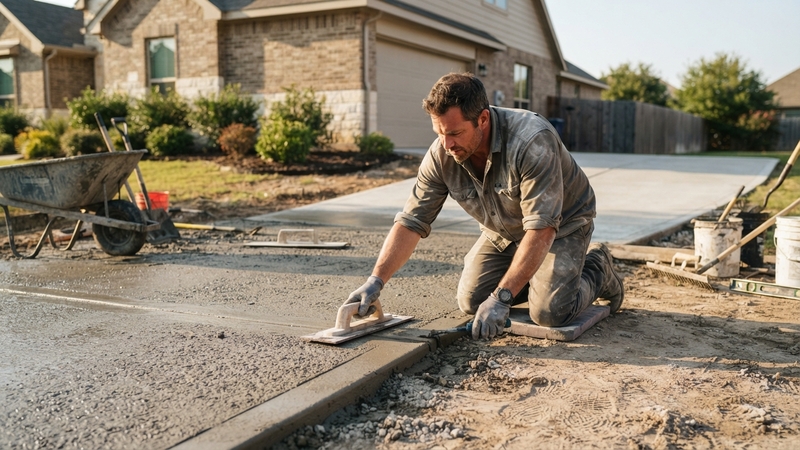
Durability problems in concrete work usually trace back to what happens before the pour, not after. A contractor who skips soil evaluation or rushes joint placement is setting up future cracking regardless of how clean the finished surface looks on day one.
- Subgrade evaluation: Settlement occurs when one portion of a driveway moves downward relative to another, and driveway edges can be particularly vulnerable because they may have less support than the center of the slab.
- Control joint planning: Control joints are cut into concrete so the slab cracks in a planned line instead of a random line across the driveway.
- Drainage design: Poor grading around a slab contributes to erosion or repeated moisture problems if drainage is not addressed during installation.
- Curing oversight: Fresh concrete can contract by roughly 1/8 inch per 20 feet during drying, which is why proper curing supervision reduces early shrinkage cracking.
This kind of attention to foundational work matters across the Inland Empire, where clay-heavy soils and seasonal temperature swings in Temecula, CA can accelerate movement beneath a slab if the base was not compacted correctly at the outset.
Comparing Contractor Practices
| Practice | Lower-Quality Contractor | Skilled Contractor |
| Licensing | Avoids providing a license number | Shares license number for verification |
| Site prep | Pours over existing soil without compaction checks | Evaluates subgrade and grading before pouring |
| Joint placement | Adds joints as an afterthought | Plans control joints with the design |
| Documentation | Verbal estimate only | Written scope covering materials and timeline |
Questions to Ask Before Signing a Contract
A short conversation before hiring can reveal more than a glossy brochure. Homeowners should ask direct questions and expect clear, specific answers.
- Can you provide your license number for verification?
- What does your site preparation process include?
- How are control joints placed on this type of project?
- What is the expected curing timeline before the surface is usable?
Based in USA, Hoffman’s Concrete Construction serves customers across Temecula, CA for residential and commercial concrete projects.
Frequently Asked Questions
How long should a properly installed concrete driveway last? Lifespan depends on soil conditions, drainage, and maintenance, but well-built concrete pavements are designed to perform for decades when base preparation and jointing are done correctly.
Is a verbal estimate enough before starting a project? A written scope is preferable because it documents schedule, payment events, change procedure, permit responsibility, warranty terms, and maintenance instructions that a verbal quote typically omits.
What is the biggest red flag when evaluating a contractor? If a contractor cannot or will not provide proof of licensing and insurance, it is best to move on to another candidate.
Should homeowners get multiple quotes? Comparing several written quotes helps homeowners evaluate scope, materials, and warranty, not just price, which gives a more accurate picture of contractor quality.
Verifying Credentials Before You Commit
Current licensing and project details for Hoffman’s Concrete Construction can be reviewed before scheduling a concrete project consultation.