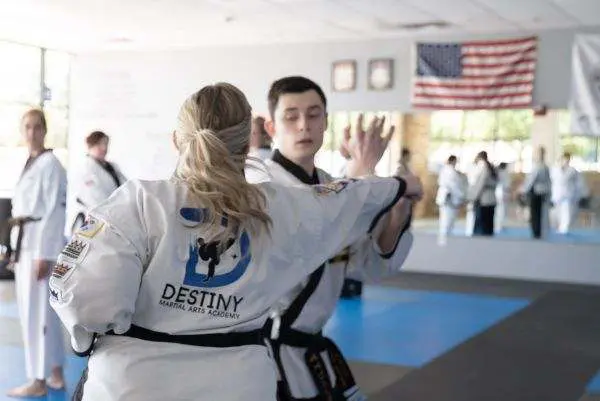
Young karate students learn personal space the same way they learn a front stance or a low block: through clear markers, short cues and a lot of friendly repetition. A 4- or 5-year-old isn’t expected to walk in knowing how far to stand from a classmate. Instructors show them where their space is, give them simple words for it and let them practice moving near other kids without bumping, grabbing or crowding.
For parents, this part of class is easy to overlook. It looks like lining up and finding a spot on the mat. But the spacing routines in a well-run preschool-age class teach body awareness, safety and respect for other people. Those skills show up later in classrooms, on playgrounds and at home.
Why Is Personal Space Hard for 4- and 5-Year-Olds?
Personal space is an abstract idea, and preschoolers think in concrete terms. Children this age are still learning to judge how much room their bodies take up and what counts as “close” or “far.” A child who spins with arms out or leans on a friend during story time usually isn’t being rude. They simply haven’t built an internal sense of where their body ends and someone else’s space begins.
The CDC’s developmental milestones give a helpful picture of where most kids are. By age 4, most children change their behavior based on where they are, acting differently at a library than on a playground. By age 5, most follow rules or take turns when playing games with other children. The CDC describes milestones as things 75% or more of children can do by a certain age, so some kids get there sooner and some later.
That timing explains why karate for 5 year olds often looks a little different from a class full of brand-new 4-year-olds. Five-year-olds can usually hold a spot longer and follow a two-part spacing direction. Four-year-olds tend to need more visual help and more reminders. Both are normal.
What Does Personal Space Look Like on a Karate Mat?
Physical educators often split space into two ideas. Self-space is the area a child can reach while staying in one place. General space is the shared area everyone moves through. California’s kindergarten physical education standards, for example, ask students to identify and use personal space, general space and boundaries, and to talk about why they matter.
A karate class uses both, sometimes within the same minute:
- Standing in a spot. During warm-ups and basic techniques, each child has a home base. Kicks and punches happen inside that space.
- Lining up. Lines teach children to leave room in front of and beside them, not just to stand still.
- Moving across the floor. Drills that travel the mat, like stepping forward in a stance, ask kids to keep a gap while the whole group moves.
- Working with a partner. Partner drills require a child to stand the right distance from one specific person and adjust when that person moves.
Martial arts gives these ideas an obvious purpose. Kids quickly learn that a kick needs room. If they stand too close, they can’t do the technique, and they might bump a friend. The lesson stops being “because the teacher said so” and becomes something they can see and feel.
How Do Instructors Teach Space Without Long Lectures?
Four-year-olds don’t learn much from a speech about boundaries. Most preschool-age martial arts programs lean on tools children can see, touch and repeat. Common ones include:
- Floor markers. Colored spots, tape lines or mat seams give each child a defined place. Early childhood teachers use the same idea with carpet squares and poly spots, because a boundary a child can see is easier to keep than one they have to imagine.
- The arm check. Children stretch their arms out to the sides. If their fingertips touch someone, they scoot until they don’t. It takes a few seconds, and kids can do it without help.
- Short, repeated cues. One or two words, like “find your spot” or “check your space,” work better than a long explanation. When the same words are used every class, children start responding before the instructor finishes the phrase.
- Movement games. Freeze games and “move without touching anyone” drills let kids practice general space while having fun. Walking slowly, then faster, then on tiptoes keeps the challenge fresh.
- Modeling. Instructors and older helpers demonstrate the right distance. Young children copy what they see far more readily than what they hear.
These routines are part of why martial arts classes for 4 year olds tend to be short, active and predictable. The structure gives kids plenty of practice with the same skill without it feeling like a lecture about rules. When parents watch a trial class of karate for 4 year olds, the spacing routine is one of the easiest things to notice: how quickly the kids find their spots, and how calmly the instructor resets the group when they drift.
How Does Partner Work Teach Respect for Other People’s Space?
Partner drills are where personal space gets real. At this age, partner work is usually simple and closely supervised. A child might punch toward a pad held by an instructor or practice a block while a partner moves slowly. Even at that level, kids have to think about another person’s body.
Several habits from partner work carry over well outside of class:
- Bowing before and after. A bow marks the start and end of working with someone. It creates a pause and a clear signal that it’s time to pay attention to another person.
- Control over power. Young students learn to aim at a target and stop where they’re told. Pulling a technique short is a way of respecting space.
- Listening for “stop.” When a partner or instructor says stop, the drill stops. Kids practice both hearing that word and using it.
That last point matters. Learning personal space isn’t only about staying out of someone else’s bubble. It’s also about knowing their own space belongs to them. Simple phrases help. PBS’s parenting site, for example, suggests teaching preschoolers to say “Excuse me, I need more space,” which lets a child state a need without blaming anyone. A child who practices that calm, clear voice in class has a model for using it on the playground, too.
How Can Parents Reinforce Personal Space at Home?
Short, playful practice at home helps class cues stick. A few ideas:
- Make a bubble. Have your child stand and “paint” the inside of an imaginary bubble with their hands. Then see who can move around the room without popping anyone else’s bubble.
- Use a boundary. A hula hoop, a towel or a tape square gives a concrete space for a quick game of “What can you do inside your space?”
- Borrow the class words. Ask the instructor which cues they use, and use the same ones at home. Matching language helps kids connect the skill across places.
- Notice it out loud. When your child gives a sibling room or waits for a turn, name it: “You left space for your sister. That was kind.”
- Practice the phrase. Role-play “I need more space” in a calm, firm voice, and respect it when your child uses it with you.
Keep it light. A few minutes a day works better than one long session, and children this age learn best through play.
What Should Parents Look for in a Class for Young Children?
Programs for this age group go by different names, and many schools call them Tiny Tigers or something similar. Whatever the label, a visit tells you more than a class schedule. Whether families are in Peoria or anywhere else, a few questions help when comparing tiny tigers martial arts classes:
- Does each child have a clear spot or line to return to?
- How do instructors handle bumping or crowding? A good answer is calm and quick, not shaming.
- How many instructors or assistants are on the mat for the number of kids in class?
- How are transitions handled, such as moving from lines to partner work?
- What happens when a child needs a break or feels overwhelmed?
It also helps to remember that these skills develop over time. If your child has ongoing trouble with body awareness, coordination or social cues that worries you, the CDC encourages parents to talk with their child’s doctor and ask about developmental screening rather than waiting.
A Small Skill With a Long Reach
Personal space can sound like a minor thing to teach in a karate class. For a 4- or 5-year-old, it’s one of the first places they learn that their body takes up room, that other people’s bodies matter too, and that they can control the distance between them. Built one spot, one cue and one bow at a time, it becomes a habit they carry into kindergarten classrooms, playgrounds and family gatherings.
About Destiny Martial Arts Academy
Destiny Martial Arts Academy is a family-owned Tang Soo Do school at 13644 N 75th Ave, Suite 103, in Peoria, Arizona, where children as young as 4 start in their Tiny Tigers program. The academy is a certified studio within the World Tang Soo Do Association, and its owners, Master Brooke Aderhold and Master Lucas Aderhold, both hold fourth-degree master rank. Families can reach them at (623) 213-8457 or find their studio on Google Maps.