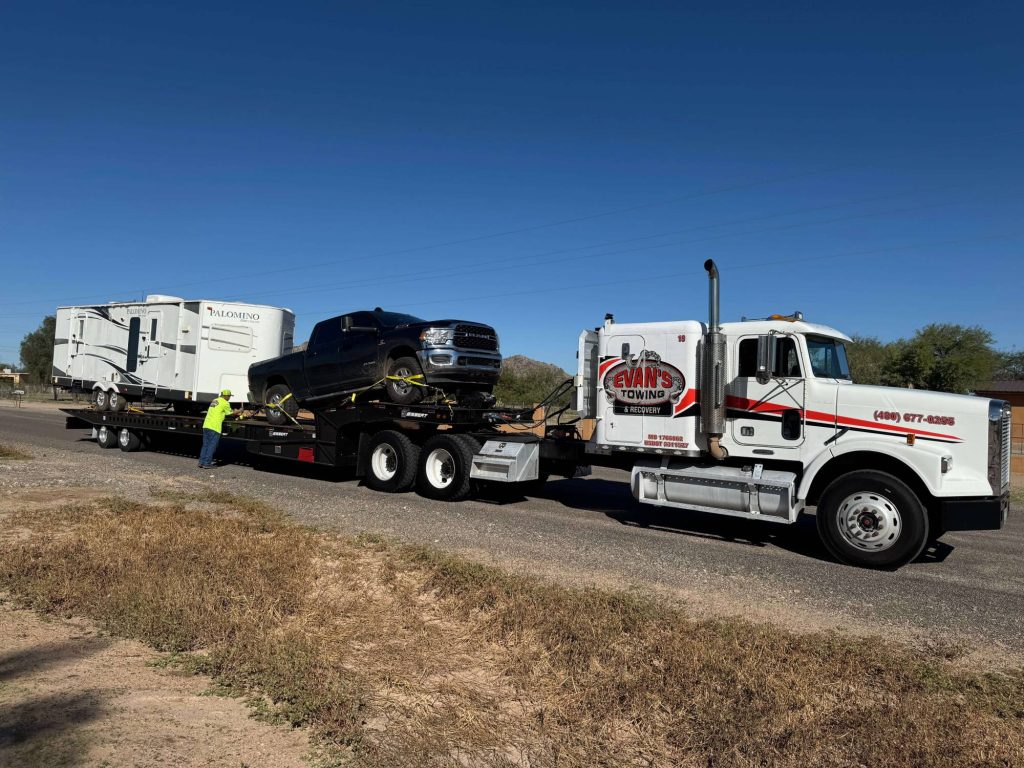
Yes, a box truck can generally be towed after a transmission failure, but the appropriate transportation method depends on the drivetrain configuration, vehicle weight, and whether its wheels can rotate without causing further damage. Professional towing operators must consider the transmission’s condition, the truck’s loaded weight, and manufacturer requirements before determining how the disabled vehicle should be transported.
A transmission failure can interrupt deliveries, prevent a commercial vehicle from leaving a business property, or leave a driver stranded during a scheduled route. Unlike a passenger car, a box truck may carry substantial cargo and have a drivetrain arrangement that requires additional attention during towing.
For businesses in Queen Creek, AZ, understanding these transportation considerations can help clarify what happens when a box truck can no longer operate normally.
What Happens When a Box Truck’s Transmission Fails?
A transmission transfers engine power through the drivetrain to the vehicle’s driven wheels. It also allows the engine and wheels to operate at different speeds through the available gear ratios.
When the transmission fails, the truck may lose the ability to transfer power properly. Depending on the problem, the vehicle might remain in one gear, fail to engage a gear, or become completely immobilized.
Not every transmission failure produces the same mechanical condition.
Some failures prevent the vehicle from moving under its own power while leaving the wheels able to rotate. Others may involve internal damage that interferes with normal drivetrain movement.
This distinction is important because a truck that cannot drive may still be movable for towing, while a truck with restricted wheel rotation requires different considerations.
Why Transmission Failure Affects More Than Driving
The transmission remains connected to other drivetrain components even after the vehicle stops operating.
In many rear-wheel-drive box trucks, these components include the driveshaft, differential, and drive axle.
Depending on the vehicle’s configuration, wheel rotation during towing can cause connected drivetrain components to move.
If the transmission is damaged or cannot be placed in an appropriate towing configuration, that movement may create additional mechanical problems.
Professional transportation must account for these connections rather than assuming the truck can be pulled normally simply because its engine is turned off.
Can a Box Truck Be Towed if the Transmission Is Stuck in Gear?
A box truck with a transmission stuck in gear may still be transportable, but the towing method must account for the restricted drivetrain.
A transmission that cannot shift into neutral can complicate transportation because the driven wheels may remain mechanically connected to the engine or transmission.
Attempting to move the vehicle without considering this condition could place unwanted stress on drivetrain components.
The appropriate method depends on the transmission design, drive axle arrangement, and manufacturer’s towing instructions.
Why Neutral Is Not Always a Complete Solution
Being able to shift into neutral does not automatically mean a damaged box truck can be towed with all its wheels on the road.
Some transmissions have lubrication requirements that depend on the engine or internal components operating normally.
When the engine is not running, certain drivetrain parts may not receive the lubrication they require during extended wheel-driven rotation.
Other vehicles have towing restrictions based on transmission type, drivetrain configuration, or mechanical condition.
For these reasons, the presence of a neutral position should not be treated as sufficient evidence that unrestricted towing is appropriate.
When the Wheels Cannot Rotate Normally
A severe transmission or drivetrain failure may prevent the driven wheels from rotating freely.
This creates another transportation challenge.
The operator must determine whether the affected wheels can be lifted or otherwise supported using suitable equipment.
Dragging wheels that cannot rotate normally may damage tires, pavement, or connected vehicle components.
Professional towing arrangements account for these mechanical limitations before vehicle movement begins.
How Does a Truck Towing Service Handle Transmission Failure?
A professional towing provider considers the mechanical condition of the truck alongside its dimensions, weight, and accessibility.
The primary objective is to transport the disabled vehicle without depending on a damaged transmission or exposing connected components to avoidable strain.
The appropriate equipment and transportation method vary with the truck.
Evaluating the Drivetrain Configuration
Many commercial box trucks use rear-wheel-drive configurations, with engine power transferred through a transmission and driveshaft to the rear axle.
Others may have different drivetrain arrangements.
These differences influence how the wheels and connected mechanical components behave during towing.
For example, a rear-wheel-drive truck with a damaged transmission may require a towing arrangement that prevents inappropriate drivetrain rotation.
The operator must also consider the manufacturer’s requirements and whether the truck has suffered damage beyond the transmission.
Selecting Suitable Towing Equipment
A box truck’s size can place it outside the operating capacity of equipment commonly used for passenger vehicles.
Medium-duty towing equipment may be appropriate for certain delivery trucks and commercial box vehicles.
Larger or more heavily loaded trucks may require a different equipment classification.
Depending on the circumstances, suitable towing arrangements may involve lifting an axle or transporting the vehicle with its wheels supported off the roadway.
No single method is appropriate for every transmission failure.
The available equipment must be rated for the truck’s actual weight and compatible with its mechanical condition.
Accounting for Vehicle Securement
Commercial trucks require appropriate securement during transportation.
The towing arrangement must account for the truck’s weight, frame configuration, axle placement, and any equipment or cargo it carries.
A transmission failure can influence whether particular wheels or drivetrain components may remain in motion.
These conditions affect how the truck should be positioned and supported.
Proper vehicle securement remains essential regardless of whether the transmission is functioning.
Does Box Truck Weight Affect the Towing Method?
Yes. Vehicle weight is one of the most important considerations when arranging towing for a disabled commercial truck.
Box trucks vary considerably in size and capacity.
A smaller delivery truck may fall within the range served by medium-duty towing equipment, while a larger vehicle may require equipment with greater lifting and towing capacity.
The relevant weight includes more than the empty vehicle.
Gross Vehicle Weight Rating Versus Actual Weight
Gross vehicle weight rating, or GVWR, represents the manufacturer’s maximum rated loaded weight for the vehicle.
Actual vehicle weight refers to what the truck weighs under its current operating conditions.
A delivery truck carrying merchandise may weigh substantially more than the same vehicle when empty.
Both the vehicle’s ratings and actual loaded condition can matter when selecting transportation equipment.
The towing operator must ensure that the equipment and towing configuration can accommodate the vehicle being moved.
How Cargo Changes Transportation Considerations
Cargo can influence axle loading and the truck’s overall balance.
A box truck transporting heavy supplies may present different loading conditions from one carrying lightweight packages.
Unevenly distributed cargo may also affect the weight carried by individual axles.
This matters because towing arrangements can transfer additional load to the towing vehicle.
An appropriate transportation assessment considers the disabled truck’s weight distribution and configuration rather than relying solely on its exterior dimensions.
Can a Loaded Box Truck Be Towed After Transmission Failure?
A loaded box truck can sometimes be towed without first removing its cargo, provided the towing equipment and transportation arrangement are suitable for the vehicle’s actual weight and condition.
However, this cannot be assumed for every situation.
A truck carrying substantial cargo may approach or exceed the capacity of available towing equipment.
The type of load can also introduce additional considerations.
For example, a vehicle transporting ordinary boxed merchandise presents different concerns from one carrying materials subject to transportation restrictions.
The towing provider must understand the relevant vehicle and cargo conditions before confirming the appropriate arrangement.
Why Load Distribution Matters
Cargo changes how weight is distributed between the truck’s axles.
When part of a disabled truck is lifted for towing, the weight transferred to the towing vehicle depends on the lifting configuration and the disabled truck’s loading characteristics.
An unsuitable arrangement could place excessive load on towing equipment or affect handling.
These issues are particularly relevant when a commercial vehicle has a long wheelbase or carries substantial weight behind its rear axle.
Professional towing assessments account for these factors when determining whether a proposed transportation method is appropriate.
Why Can Transmission Damage Make Ordinary Towing Risky?
Unlike a simple engine shutdown, transmission failure can affect components that remain mechanically connected to the wheels.
The potential consequences depend on the transmission design and the nature of the failure.
In some vehicles, rotating the driven wheels while the transmission is not operating normally may cause additional damage.
Manufacturer instructions provide an important reference for these limitations.
For example, the 2024 Ram Commercial Chassis Cab owner’s manual distinguishes among flat towing, wheel-lift towing, and flatbed transportation. Its guidance identifies different restrictions for two-wheel-drive and four-wheel-drive configurations and specifies conditions under which certain towing methods are permitted.
This illustrates a broader principle: commercial vehicle towing requirements are configuration-dependent.
The guidance for one chassis cannot automatically be applied to every box truck.
A vehicle with an already damaged transmission may require additional precautions beyond those described for an otherwise mechanically functional disabled truck.
What if Transmission Failure Happens During a Delivery Route?
A box truck breakdown during a delivery route can affect more than the vehicle itself.
The driver may be carrying scheduled deliveries, business equipment, or products intended for several destinations.
When the truck becomes immobilized, the business must address transportation while also managing the operational interruption.
Emergency towing can help move the disabled vehicle from its current location to an appropriate destination.
Breakdowns on Commercial Roads
A box truck may experience transmission failure while traveling through a commercial district or approaching a delivery destination.
Its position can affect how a towing vehicle reaches and accesses it.
A disabled truck stopped near moving traffic creates additional concerns involving nearby motorists and the working area available for transportation equipment.
The vehicle’s dimensions and weight can make those conditions more complicated than a typical passenger-car breakdown.
Where traffic hazards are present, roadway authorities or emergency responders may need to manage the scene.
Breakdowns at Loading Docks
A transmission failure can also occur while a truck is parked at a loading dock or warehouse.
In this situation, the immediate challenge may involve restricted access rather than traffic.
Loading docks often have limited maneuvering space, nearby buildings, and other commercial vehicles operating in the area.
The position of the disabled truck can influence the equipment needed to reach and transport it.
Breakdowns in Business Parking Areas
Some box trucks become disabled while parked at a commercial property.
A truck positioned close to a wall, loading area, or other vehicle may be difficult to access using conventional towing arrangements.
The available space and ground conditions must be considered alongside the damaged transmission.
An appropriate assessment helps determine whether the towing equipment can approach and move the vehicle under the existing conditions.
Does a Transmission Failure Affect the Towing Destination?
Yes. A box truck with transmission damage will generally require mechanical evaluation before returning to commercial use.
This makes the transportation destination an important consideration.
The truck may need to be delivered to a commercial vehicle repair facility capable of accommodating its dimensions and addressing the suspected drivetrain problem.
Not every automotive repair shop is equipped or configured to receive larger box trucks.
Repair Facility Access
Commercial repair facilities may have different entrances, parking areas, and vehicle-handling capabilities.
A longer box truck can require more maneuvering room than a passenger vehicle.
The destination must also be suitable for receiving and unloading a disabled commercial truck.
These considerations can affect transportation planning, particularly when the vehicle cannot move under its own power.
Why Towing and Repair Are Separate Services
Towing addresses the immediate transportation problem.
Transmission diagnosis determines the cause of the mechanical failure and identifies what repairs are necessary.
A truck may require transmission repair, replacement, or attention to another connected drivetrain component.
Those decisions belong to qualified commercial vehicle repair providers.
Professional towing helps move the disabled truck to a location where the necessary mechanical evaluation can take place.
Why Is Professional Transportation Important for Commercial Trucks?
A box truck with transmission failure presents several interacting challenges.
Its drivetrain may be damaged, its wheels may not rotate normally, and its weight may exceed the capacity of standard passenger-vehicle towing equipment.
Cargo and vehicle dimensions can introduce further limitations.
Professional towing accounts for these considerations when determining how the vehicle can be transported.
For commercial operators seeking a Truck towing service in Queen Creek, the relevant question is whether the provider can accommodate the truck’s weight, configuration, and mechanical condition.
An appropriate towing arrangement should address the vehicle’s drivetrain restrictions rather than simply attempting to move it with whatever equipment is available.
This approach can reduce the likelihood of avoidable transportation-related damage while helping the business arrange mechanical repairs.
What Should Fleet Managers Understand About Transmission-Related Towing?
Transmission failure does not automatically make a commercial box truck impossible to transport.
However, it can substantially influence how transportation should be arranged.
The truck’s drivetrain design, actual loaded weight, axle configuration, and wheel movement all affect equipment selection.
Its location and intended destination also matter.
A disabled truck in an open industrial parking area may present different access conditions from one stopped at a narrow loading dock or alongside traffic.
Fleet managers benefit from working with a towing company that can assess these circumstances and determine whether its equipment is appropriate for the vehicle.
The primary objective is to transport the truck to a suitable destination without depending on a transmission that may no longer function correctly.
Professional Towing Helps Businesses Move Beyond a Breakdown
A transmission failure can bring a box truck’s scheduled work to an unexpected stop, but the vehicle can often still be transported.
The appropriate method depends on the damaged drivetrain, the truck’s weight, available equipment, and the surrounding conditions.
Professional towing provides a practical way to move a disabled commercial vehicle toward inspection and repair without requiring it to continue operating with a compromised transmission.
For businesses in Queen Creek and nearby communities, understanding these considerations helps clarify why commercial truck transportation requires more than simply attaching a tow truck.
A properly evaluated towing arrangement supports the next step in restoring the vehicle to service while accounting for the mechanical and transportation limitations created by the breakdown.
About Evan’s Towing & Recovery LLC
Evan’s Towing & Recovery LLC is a family-owned towing and roadside assistance company founded in 2019 and based in Queen Creek, Arizona. Serving local drivers and commercial vehicle operators, they provide light-duty, medium-duty, and heavy-duty towing, including transportation for qualifying box trucks, and their website identifies the company as licensed, bonded, and insured. Businesses needing assistance can reach them at (480) 677-0255 or view their location on Google Maps.